
Security researcher Tobia Righi has pulled off what appears to be the first successful passkey phishing attack.
The phishing vector existed solely in mobile browsers and has now since been patched. Security updates have rolled out for all major browsers, such as Chrome / Edge (October 2024), Firefox (February 2025), and Safari (January 2025)—see CVE-2024-9956 .
Righi’s attack revealed that passkeys are not perfect, but his research also showed that passkeys are far superior to the old credential pair and classic multi-factor authentication solutions.
The attack was far more difficult to pull off and had a far more narrow scope than current web-delivered phishing kits, which you can host on any website together with a proxy server and even intercept MFA challenges.
Instead, Righi’s technique required that an attacker place a hardware device within a victim’s Bluetooth LE range, which is between 70 and 100m.
The device, which could be a tiny Raspberry Pi hidden in an attacker’s backpack, would be used to host a custom web server that triggered a passkey authentication flow.
In the simplest explanation possible, an attacker within BLE range can trick a victim into using their passkey to log the attacker’s (Raspberry Pi) device into their account.
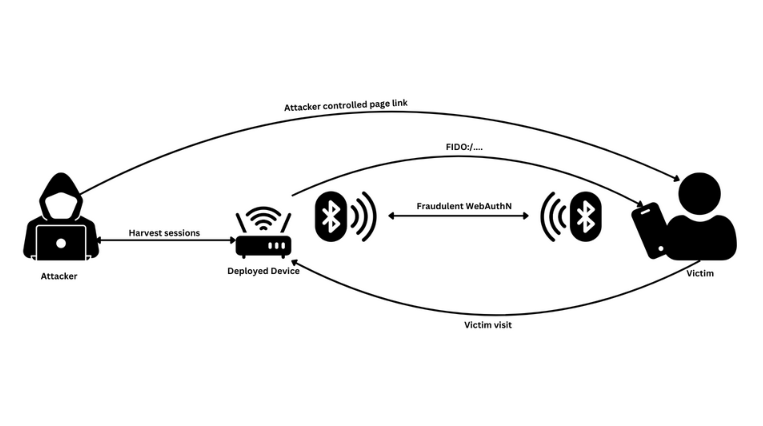
Let’s go over one of Righi’s examples to showcase how this was possible:
- An attacker deploys their rogue Raspberry Pi in a crowded airport.
- The attacker advertises a rogue free airport WiFi that requires users to log in using one of their social media accounts but via their passkeys instead of using a password.
- A victim chooses this option. The rogue BLE device, acting as an intermediary, initiates a WebAuthn request on the user’s behalf.
- The attacker’s BLE device would normally be prompted to scan a QR code, but Righi discovered you can extract a FIDO:/ link from the QR code and just redirect the victim to it instead.
- The victim is prompted to authenticate against the FIDO, not knowing that the successful authentication allows the attacker’s device into their account.
- The attacker extracts the session data from the rogue BLE device and logs into the victim’s account.
The bug here, and what browser vendors fixed, is that the FIDO:/ link was navigable and basically allowed to bypass the actual scanning of the QR code.
The victim is never aware of an intermediary hardware device that was doing a proxy authentication on their behalf.
This was basically a current MitM/AitM attack but carried out using hardware and adapted to passkeys and FIDO standards.
Righi says browser makers have now blocked FIDO:/ URI schemes from being navigable, which, in theory, should stop his version of the attack.
The researcher has open-sourced the server software that ran on the rogue BLE (Raspberry Pi) device to allow other researchers to evolve his technique and find new ways to exploit it.
Source: https://risky.biz/risky-bulletin-passkeys-are-phishable-but-quite-difficult-through/